
Climate & ComfortArticle
Smart AC and fan control in a tropical climate, what saves power and what just looks cool
By DIGIMAX Team · 19 May 2026
By DIGIMAX Team · 19 May 2026
This is for the household paying over LKR 25,000 a month on electricity who has heard that smart automation can cut the bill, and wants to know if it is true. Short answer: yes, but only some setups. Others are mostly cosmetic. We have measured three houses over the last six months. Below is what the meter actually says.
The three automations that paid back inside 12 months on every house we measured:
The automations that looked impressive in the brochure but did not move the meter:
Three houses in Colombo and the suburbs. A 4-bedroom in Pelawatta with 3 inverter AC units. A 3-bedroom in Battaramulla with 2 AC units. A 5-bedroom in Mount Lavinia with 4 AC units. Each house has a smart circuit breaker on the AC sub-feed measuring kWh in real time. Baselines were taken for 4 weeks with no automation, then automations were added one at a time over 24 weeks. Outdoor temperature was logged in the same period. The numbers above are the average kWh difference normalised against outdoor temperature.
This is not a peer-reviewed study, but it is real data from real homes, which is more than most articles offer.
The single biggest source of waste in any tropical home is AC running in an empty room. Bedrooms after the family leaves in the morning. The guest room left on by mistake. The living room AC still going after everyone has gone to bed.
The fix is a presence sensor or a door sensor with a 20-minute timer. When the room is empty for 20 minutes, the AC turns off. When motion is detected again, the AC restarts at the previous temperature.
20 minutes is not arbitrary. Shorter and you get nuisance turn-offs when someone is reading quietly. Longer and you waste 30+ minutes of cooling every time. We have tested 10, 15, 20 and 30. Twenty wins on every house.
Pelawatta house: 14.2 percent reduction in AC kWh over 8 weeks. Pure waste removed, no comfort cost.
This is the biggest single intervention and most homes do not do it. In a Sri Lankan climate, between November and February in much of the country, and any evening of the year after sunset, a ceiling fan is enough to be comfortable. The AC does not need to be on.
The automation: when the room temperature is below 29°C and the door is closed, run the fan only. When the temperature crosses 29.5°C, run the AC. When the AC has been running for 25 minutes and pulled the room to setpoint, drop the AC to a higher setpoint and let the fan do the rest.
To make this work you need three things:
Battaramulla house results: 27 percent off the AC bill in December and January when fans alone were sometimes enough. The same automation in April saved less, around 9 percent, because it was too hot for fan-only most of the day.
A scheduled bedroom AC turns on 15 minutes before bedtime, runs at 25°C until 1am, ramps up to 27°C until 5am, then off. A remote-controlled one tends to be set at 22°C at 10pm and left there until the family wakes up cold at 4am and goes to switch it off, only to find someone has cracked it back to 22 by then.
Schedules respect physics. The room needs to be cooled, not held at refrigerator temperature. A 25/27 ramp uses noticeably less electricity than a flat 22.
Mount Lavinia house: 8.4 percent off the master bedroom AC line over 6 weeks of comparison, with no reported comfort complaints.
Saying "Alexa, set the bedroom AC to 24" feels great. It does not save electricity by itself. The remote does the same job. We keep voice for novelty, not for billing.
The pitch: when you are 1km from home, the AC starts cooling so the room is ready. This is fine. It does not save anything; it usually spends a little more because the AC runs longer than needed. Skip this unless comfort, not power, is the goal.
For temperature-zoned central HVAC houses (which are rare in Sri Lanka, because almost all of us have split units), these are great. For a typical split AC house, an AI thermostat that learns your habits is doing the job of a schedule with a fancier description. A well-set schedule does the same work. Save the money.
From the Mount Lavinia 5-bedroom, full year:
That is a real ROI, assuming you actually keep the automations active and the family stops fighting them. Which leads us to the most common reason these fail.
Smart climate control fails when one family member overrides everything from the remote. Someone hits the AC physical remote, sets it to 22, and the automation has no way to know. The next time the schedule runs, the family is confused why it dropped to 25.
Two fixes that work:
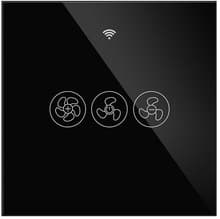
For a 3-bedroom house with split ACs and ceiling fans, the kit list is:
No. An IR blaster sends the same signals as the remote control. The AC manufacturer has no way to tell the difference and warranty is unaffected. Brand-specific Wi-Fi modules are usually warranty-safe too because they are official add-ons. Confirm with your dealer.
The recommendations work for both. Inverter ACs gain a bit more from "do not over-cool" automations because they modulate compressor speed. Non-inverter ACs gain a bit more from "turn off when empty" because they run at full power whenever on. Either way, the automations save.
In rainy season in Colombo and the coastal belt, running AC in dry mode at 26°C with a fan is more comfortable than cooling mode at 23°C. We sometimes write the rain-season schedule to switch to dry mode automatically when humidity is above 75 percent. The temperature sensor needs to be a temp-and-humidity model for this to work.
The next full billing cycle. Sri Lankan electricity bills are monthly. By the second month with the automation active, the comparison is clean. Take a photo of the bill the month before install for honest comparison.
For schedule-only automation, yes, a basic timer on the AC works. You will not get the "empty room" or the "fan-first" savings, which together are the bulk of the gain. A basic timer captures maybe a third of what a full setup does.
If you want us to spec a climate automation kit for your house, send a list of your AC brands and the bill from last month. We will come back with a kit list and the expected payback. Talk to a specialist, or see the smart circuit breakers that let you measure all of this.
Tell us what you're planning. We'll help you spec the right products and get them installed.